Rosacea

What is Rosacea?

Rosacea is a chronic inflammatory skin condition that primarily affects the central face. It often appears as persistent redness and flushing and can include visible blood vessels and acne-like bumps.

Common symptoms include:
Rosacea affects an estimated 415 million people worldwide, with the highest prevalence among individuals of fair skin.

Epidemiology

Rosacea prevalence varies by geographic region and ancestry.

Estimated prevalence rates:
Rosacea occurs most frequently in individuals with fair skin and Northern European ancestry, historically leading dermatologists to refer to the condition as “the curse of the Celts.”

The Underlying Problem: Oxidative Stress

Growing scientific evidence suggests that oxidative stress plays an important role in rosacea.

Oxidative stress occurs when reactive oxygen species (ROS)—often called free radicals—exceed the body’s antioxidant defenses.

Reactive oxygen species are unstable molecules produced during normal biological processes such as:

When ROS accumulate in excess, they can damage:

This cellular damage can contribute to inflammation and redness characteristic of rosacea.

Triggers That Increase Oxidative Stress

Rosacea flare-ups are often triggered by factors than increase oxidative stress.

Examples include:

These triggers increase oxidative stress and can worsen rosacea symptoms.

The Body’s Natural Defense System

The body protects itself from oxidative stress using antioxidants.

One of the most important cellular antioxidants is glutathione, often called the “master antioxidant” because it protects cells by:

Why Endogenous Glutathione Matters

Glutathione works inside cells, where oxidative damage occurs.

The body naturally produces glutathione internally—this is called endogenous glutathione.

Healthy endogenous glutathione levels helps support:

When antioxidant defenses become overwhelmed by ROS, oxidative stress increases and inflammation can occur.

What Research Shows

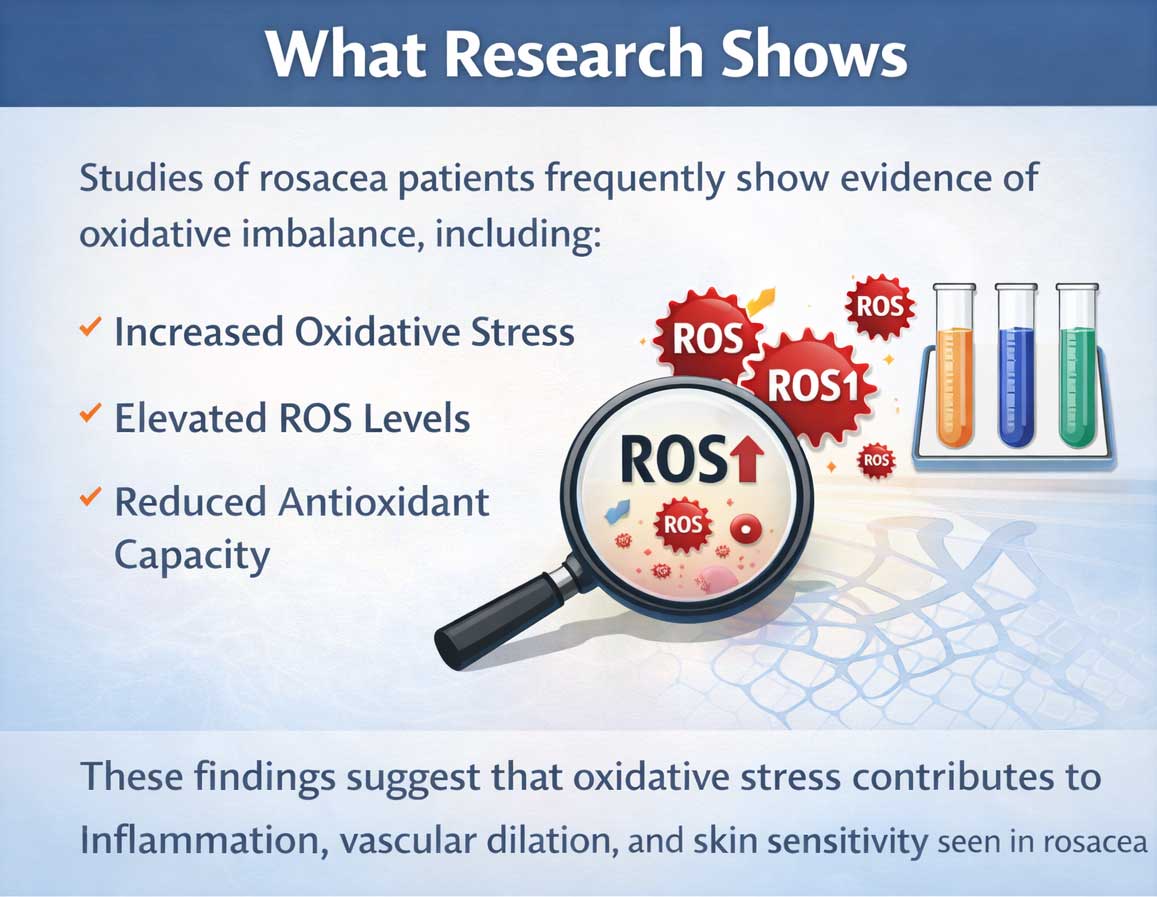
Studies of rosacea patients frequently show evidence of oxidative imbalance, including:

These findings suggest that oxidative stress contributes to inflammation, vascular dilation, and skin sensitivity seen in rosacea.

Biological Processes Involved in Rosacea

Dermatologic research identifies three major biological mechanisms contributing to rosacea.

1. Innate Immune System Dysregulation

Rosacea patients demonstrate abnormal activation of the innate immune system, including: 

These immune responses promote inflammatory signaling and vascular changes in the skin.

2. Neurovascular Dysregulation

Facial blood vessels and sensory nerves can become overly reactive, leading to flushing, redness, and heightened skin sensitivity.

3. Oxidative Stress

Numerous studies demonstrate increased oxidative stress in rosacea skin.

Research has identified:

Oxidative stress contributes to inflammation, vascular dilation, and tissue damage.

How Oxidative Stress Leads to Symptoms

When ROS levels exceed the skin’s antioxidant defenses, the following cascade can occur: ROS accumulation🡪oxidative stress🡪inflammation🡪rosacea symptoms

Current Medical Treatments

Most medical treatments focus on reducing inflammation and oxidative stress in the skin.

Common therapies include:
Topical treatments:

Oral medications:

Procedural therapies:

Summary

Rosacea is a chronic inflammatory skin disease involving multiple biological processes. Research increasingly shows that oxidative stress and reduced antioxidant defenses play a key role in the condition.

Triggers that increase ROS production can worsen symptoms, which the body’s antioxidant systems—particularly endogenous glutathione—help protect skin cells from oxidative damage.

Understanding the role of oxidative stress may help guide future approaches to managing rosacea.

References

  1. Gether L, et al. Global prevalence of rosacea. British Journal of Dermatology. PMID: 29478264. Incidence and prevalence of rosacea: a systematic review and meta-analysis – PubMed
  2. Yamasaki K, Gallo RL. The molecular pathology of rosacea. Journal of Dermatological Science. PMID: 19303241. The molecular pathology of rosacea – PubMed

Studies Linking Rosacea to Other Diseases

  1. Tsung-Yu T. 2020. Acta Dermato-Venereologica. PMID: 33073295. Cardiovascular Risk and Comorbidities in Patients with Rosacea: A Systematic Review and Meta-analysis — A meta-analysis found rosacea patients had higher blood pressure, cholesterol, C-reactive protein, and insulin resistance compared with controls.
  2. Tuan-Chun Hua, et al. 2015. Journal of the American Academy of Dermatology. PMID: 26004520. Cardiovascular comorbidities in patients with rosacea: A nationwide case-control study from Taiwan — Patients with rosacea are more likely to have dyslipidemia, hypertension, and coronary artery disease.

Neurological Disorders

  1. Egeberg A, et al. 2017. Journal of the American Academy of Dermatology. Prevalence and risk of migraine in patients with rosacea: A population-based cohort study — A nationwide cohort study found increased migraine prevalence among rosacea patients, particularly in women.
  2. Multiple studies on rosacea and comorbidity

Gastrointestinal Disorders

  1. Wang F, Chi C. 2021. Springer Nature. PMID: 33507499. Rosacea, Germs, and Bowels: A Review on Gastrointestinal Comorbidities and Gut–Skin Axis of Rosacea
  2. Wang F, Chi C. 2019. Medicine. Association of rosacea with inflammatory bowel disease

Psychiatric Disorders

  1. Woo YR, et al. 2020. International Journal of Molecular Sciences. Updates on the Risk of Neuropsychiatric and Gastrointestinal Comorbidities in Rosacea and Its Possible Relationship with the Gut–Brain–Skin Axis — Studies have shown rosacea patients have higher odds of mental health disorders, partly due to the visible nature of facial symptoms and systemic inflammatory factors.

Cardiovascular Disease

  1. Alharbi A, et al. 2024. Journal of Pharmaceutical Research International. A Holistic Review of Rosacea and Its Association with Cardiovascular Diseases

Search topics, conditions, science